











Asian markets began the week on a defensive note, as investors confronted a sharper geopolitical shock.
What hit sentiment was not only the latest round of fighting in the Middle East, but the market’s growing sense that the conflict is becoming more entrenched.
That combination pushed traders to cut risk across equities, with the heaviest selling concentrated in North Asia.
Oil-sensitive economies are especially vulnerable to a sustained increase in energy prices, which have remained highly volatile as the conflict enters its fifth week.
War fears trigger a broad risk-off open
Equities in Asia fell across the board on Monday, and the retreat underscored how quickly geopolitical stress can impact regional risk appetite.
South Korea bore the brunt of the selloff, with the Kospi down more than 5% and the Kosdaq off 3.97%.
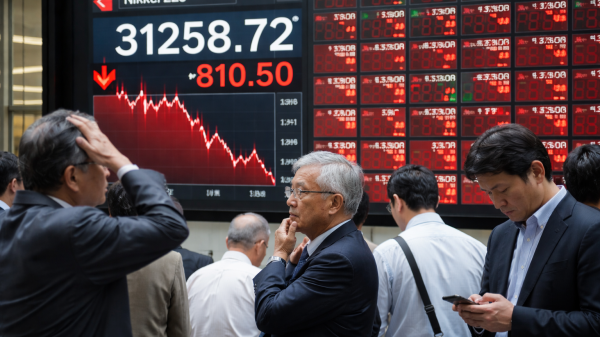
Japan was also hit hard, as the Nikkei 225 fell 3.97% and the broader Topix lost 3.9%.
Australia’s S&P/ASX 200 dropped 1.46%, while Hong Kong’s Hang Seng fell 1.52% and mainland China’s CSI 300 lost 0.77%.
The sweep of declines pointed to a classic flight from risk, as investors moved to price in the possibility that the Middle East war could drag on and inflict a deeper energy shock.
The market mood was cautious rather than chaotic.
Investors were not reacting to a single isolated headline, but to the cumulative realization that the war is broadening in ways that make the outlook harder to model.
Weekend developments, including missile attacks on Israel by Yemen’s Iran-aligned Houthis, added to the sense that the conflict is spilling across more fronts.
Oil shock ripples through Asia
For Asian investors, the most important link between a distant war and local stock prices is crude.
Brent surged to around $115 a barrel on Monday and is heading for a record monthly jump, having risen about 59% in March.
Markets are focusing not just on current supply, but on the possibility that the conflict could further disrupt flows through the Strait of Hormuz.
In Asia, that matters more as many of the region’s largest economies are major energy importers.
Higher oil prices feed into factory input costs, shipping bills, aviation fuel, electricity prices and household spending power.
They also squeeze corporate margins at a time when growth is already uneven.
The result is a damaging chain reaction where war risk lifts crude, higher crude worsens inflation fears, and inflation fears drag on equities by threatening both profits and consumer demand.
Asia is not simply reacting in sympathy to overseas headlines.
It is responding to a direct macroeconomic transmission channel.
A prolonged oil shock would hit import-dependent economies first and force investors to rethink everything from earnings forecasts to rate expectations.
The post Kospi plunges 5%, Nikkei 4% as war fears, $115 oil shake Asian markets appeared first on Invezz